SENAME
Introduction
In the field of public policy and child protection, few subjects in contemporary Chile are as complex—or as deeply debated—as the National Service for Minors (Servicio Nacional de Menores, SENAME). Created in 1980 under the Ministry of Justice, SENAME was assigned a dual mandate: to safeguard the fundamental rights of children and adolescents living in situations of vulnerability, while managing the social reintegration of youth between the ages of 14 and 17 who had come into conflict with the law (SENAME, n.d.).
When Chile ratified the UN Convention on the Rights of the Child in 1990, the state formally bound itself to international standards of child welfare. In theory, public institutions were designed to intervene where family networks or social safety nets had broken down. However, state intervention in child welfare exists in a delicate space. Over the decades, public inquiries, administrative audits, and media reports revealed recurring instances of negligence, physical abuse, and psychological distress across various facilities nationwide.
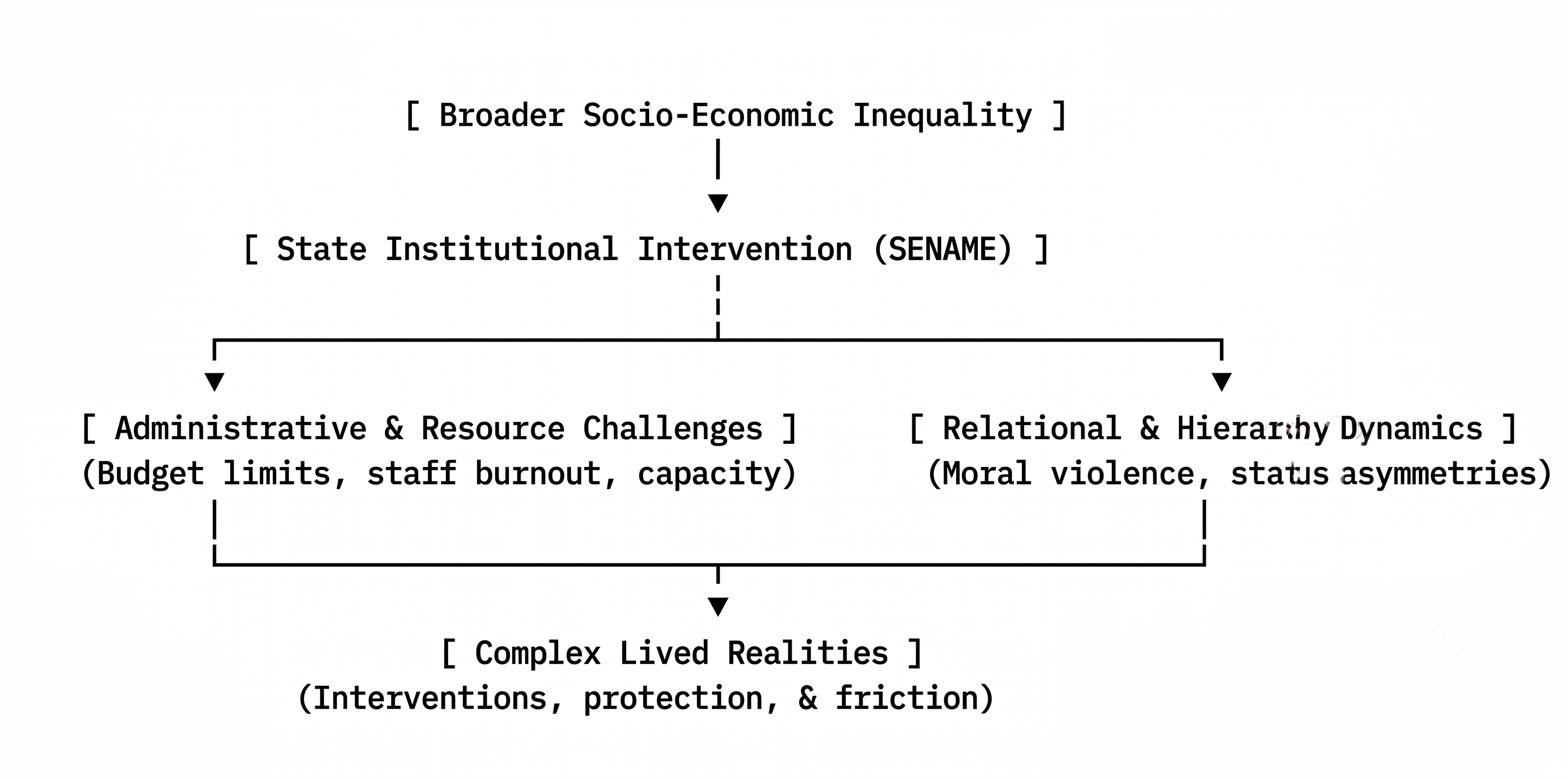
This reality raised a profound sociological dilemma. State agencies designed to protect vulnerable youth often found themselves reproducing the very conditions of distress they were meant to alleviate. To examine this phenomenon realistically, we must avoid viewing public institutions through simplified binaries—such as total benevolence on one hand or intentional harm on the other. Instead, we can explore how structural tensions, organizational power dynamics, and broader socio-economic factors shape the everyday realities of institutionalized youth.
Sociological Perspectives on Institutional Dynamics
1. Structural Context and Institutional Frameworks
Public child welfare systems rarely exist in a vacuum; they inevitably reflect the broader socio-economic conditions of the society that creates them. Chile’s economic trajectory over recent decades has been characterized by significant structural growth alongside persistent social inequality and territorial segregation (Sepúlveda, 2019). Within this context, institutions like SENAME primarily serve youth from low-income or socially marginalized households (Olivares, 2021).
From a structural perspective—drawing on Louis Althusser’s (2003) concept of State Apparatuses—public institutions can be interpreted as mechanisms that maintain social order. When families lack the financial, emotional, or community resources to support child development, the state steps in to fill the void. However, when public residences operate under severe budget constraints, bureaucratic centralization, or overcrowding, the institution itself can unintentionally reinforce social margins rather than resolve them.
When social tension reaches a boiling point, public grievances can spill into the streets. During Chile's 2019 social movement (Estallido Social), reports highlighted that several young protesters involved in street blockades had spent time in state residential care (La Voz de los que Sobran, 2020). From a critical standpoint, such behavior can be interpreted as an outward expression of frustration against an administrative system perceived as distant or punitive. In classical political theory, such as Vladimir Lenin’s (1997) analysis of state structures, public institutions often reflect wider societal power imbalances, making fundamental reform a challenging, friction-filled endeavor.
2. Moral Violence and Informal Hierarchies
Beyond legal and administrative structures, social life inside residential centers is heavily influenced by informal power relations. Anthropologist Rita Laura Segato (2003) offers a useful framework through her concept of moral violence—defined as subtle, non-physical mechanisms of control that preserve status hierarchies and social distance within institutions.
In total or semi-closed institutions, power asymmetries between staff and residents are pronounced. Segato (2003) notes that institutional control often manifests through the regulation of daily habits, mobility, and social interactions. When staff lack adequate training, mental health support, or institutional resources, informal disciplinary practices can take root.
In some cases, testimonies from former residential educators reveal how institutional stress and rigid hierarchies created environments where coercive discipline was normalized as a tool for basic order (Riquelme, 2018). For institutionalized youth, experiencing persistent psychological or moral friction can lead to emotional detachment—a phenomenon the World Health Organization (WHO) identified when evaluating the long-term impacts of early family separation and prolonged institutionalization (Morales, 2013).
3. Identity and the Challenge of Social Inclusion
Sociologists Michael Hardt and Antonio Negri (2011) argue that modern social struggles often center on identity and representation. While public discourse frequently addresses identity around organized social movements, youth living in state care often embody a denied identity (identidad negada)—a population lacking political representation, economic leverage, or organized advocacy networks.
When young people age out of state care without strong community ties or educational continuity, they face a heightened risk of social drift, homelessness, or involvement in the criminal justice system (Canal T13, 2016). Analyzing identity politics in this sphere suggests three constructive avenues for institutional transformation (Hardt & Negri, 2011):
-Making Structural Tensions Visible: Acknowledging institutional shortcomings objectively, without minimizing achievements or exaggerating systemic failures.
-Channeling Indignation into Reform: Moving from public outrage toward constructive, evidence-based policy design and multi-sectoral collaboration
-Evolving Institutional Models: Transitioning from large-scale, closed administrative facilities toward decentralized, community-based, and family-centered protective models.
Empirical Realities and Policy Responses
The difficulties facing SENAME are well-documented across multiple sectors of Chilean society:
-Administrative Burden: Official data recorded over 4,500 formal administrative or legal complaints regarding conditions or incidents within centers in 2020 alone (Matus, 2021), reflecting both real operational strain and increased regulatory oversight.
-Public Visibility and Scrutiny: Recognizing these deep structural limitations, Chilean policymakers initiated legislative overhauls to replace SENAME with specialized agencies—separating the protection of vulnerable children (Servicio de Protección Especializada) from the administration of youth justice (Servicio Nacional de Reinserción Social Juvenil).
-Systemic Transition: Transitioning from large-scale, closed administrative facilities toward decentralized, community-based, and family-centered protective models.
Brief Conclusion
A realistic sociological reading of SENAME demonstrates that public child protection is an intrinsically challenging domain where legal ideals encounter practical operational constraints. Rather than viewing the crisis through a single political lens, the evidence suggests that institutional vulnerability stems from a combination of historical socio-economic inequalities, organizational power asymmetries, and administrative design limitations.
Meaningful progress in child welfare requires balancing critical oversight with pragmatic governance. By pairing structural reform with robust community support networks, policy design can move toward models that prioritize the dignity, emotional stability, and long-term integration of vulnerable children.
References
-Althusser, L. (2003). Ideología y aparatos ideológicos de Estado. Nueva Visión.
-Canal T13. (2016, October 11). Los ex niños del Sename que viven en la calle [Video]. YouTube. https://www.youtube.com/watch?v=pLkInt865Kw
-El Mostrador. (2021, March 24). Manifestaciones frente a residencia del Sename en Providencia tras acusaciones de maltrato infantil. El Mostrador. https://www.elmostrador.cl/dia/2021/03/24/manifestaciones-frente-a-residencia-del-sename-en-providencia-tras-acusaciones-de-maltrato-infantil
-Hardt, M., & Negri, A. (2011). Commonwealth: El proyecto de una revolución del común. Akal.
-La Voz de los que Sobran. (2020, November 20). “Abandonados: vida y muerte al interior del sename”: el estallido social y los niños y jóvenes del sename en la primera línea. https://lavozdelosquesobran.cl/abandonados-vida-y-muerte-al-interior-de-sename-el-estallido-social-y-los-ninos-y-jovenes-de-sename-en-la-primera-linea/
-Lenin, V. I. (1997). El estado y la revolución. Fundación Federico Engels.
-Matus, J. (2021, March 22). Sename registró 4.500 denuncias por maltrato a menores en 2020. La Tercera. https://www.latercera.com/nacional/noticia/sename-registro-4500-denuncias-por-maltrato-a-menores-en-2020/LLQXJAJHJBCUXFPCI3RHRES3ZY/
-Morales, C. (2013, August 19). Crisis del SENAME: un sistema que hiere cuando intenta cuidar. CIPER Chile. https://www.ciperchile.cl/2013/08/19/crisis-del-sename-un-sistema-que-hiere-cuando-intenta-cuidar
-Olivares, B. (2021, March 29). El fin del Sename y la pobreza como fondo. El Mostrador. https://www.elmostrador.cl/noticias/opinion/2021/03/29/el-fin-del-sename-y-la-pobreza-como-fondo/
-Riquelme, J. (2018, March 9). Sename en primera persona. La Tercera (Paula). https://www.latercera.com/paula/sename-primera-persona/
-Segato, R. L. (2003). Las estructuras elementales de la violencia: Ensayos sobre género entre la antropología, el psicoanálisis y los derechos humanos. Universidad Nacional de Quilmes Editorial.
-SENAME. (n.d.). Nuestra institución. Servicio Nacional de Menores.
-Sepúlveda, P. (2019, October 24). ¿Qué tan desigual es Chile? La Tercera. https://www.latercera.com/que-pasa/noticia/que-tan-desigual-es-chile/871225/
-Ulloa, C. (2021, March 25). Video con gritos de auxilio desata investigación por violencia en centro de menores del estado chileno. CNN en Español. https://cnnespanol.cnn.com/2021/03/25/video-gritos-auxilio-investigacion-chile-orix/
About the Author
Writing this article brought up a profound personal and professional dilemma for me. While I fully recognize the grim reality inside certain SENAME centers—where unfit individuals are undeniably placed in charge of vulnerable children—I also know another side of the story firsthand through my father.
He used to work there years ago as a driver, a man who was both strong and deeply sensitive. When I was a child, I accompanied him on a few occasions. Over time, he shared many anecdotes with me, and I also witnessed several of those situations myself: parents arriving under the influence of alcohol or drugs to visit their children, sometimes becoming hostile and picking fights with the staff. I know that reality exists because I saw it with my own eyes.
Yet, as a sociologist, I cannot ignore the severe abuse, neglect, and systemic aggression documented in other facilities across the country. Balancing those lived childhood memories with critical sociological analysis is precisely what allowed me to approach this text from a realistic, grounded, and genuinely objective perspective.