Rethinking Care: From Practices to Onto-Politics.
Introduction: From Domestic Duty to Ontological Necessity
How does an act as seemingly localized and intimate as care transform into the foundational matrix of social ontology? For decades, sociological inquiries comfortably relegated care to the domestic sphere, framing it either as an ethical disposition or as a gendered form of reproductive labor. While these foundational perspectives successfully dismantled the bourgeois separation between the public and private spheres, they frequently left unquestioned an underlying assumption: that care is an exclusively human transaction between pre-existing, autonomous subjects.
However, when we look closer at the contemporary friction of global care chains, technological dependencies, and ecological fragility, this humanist framework begins to fracture. What if care is not something we do, but the very condition of being? By tracing a double displacement—first, from individualist agency to relational interdependence, and second, from public policy to an expansive understanding of the political—we are forced to ask: to what extent can sociology continue to analyze social order without accounting for the non-human scaffolding that keeps our common world from collapsing?
The Logic of Tinkering: Displacing Rational Choice and Rights
To capture the empirical reality of care, sociology must confront the hegemony of modern socio-political rationalities. In the landscape of late modernity, social action is typically evaluated through two main lenses: the logic of choice—which presumes a rational, market-driven actor exercising autonomy—and the logic of rights—which operates within the state-citizen legal apparatus. Yet, when observing care in practice, particularly within clinical, agricultural, or disabled environments, these frameworks appear remarkably inadequate.
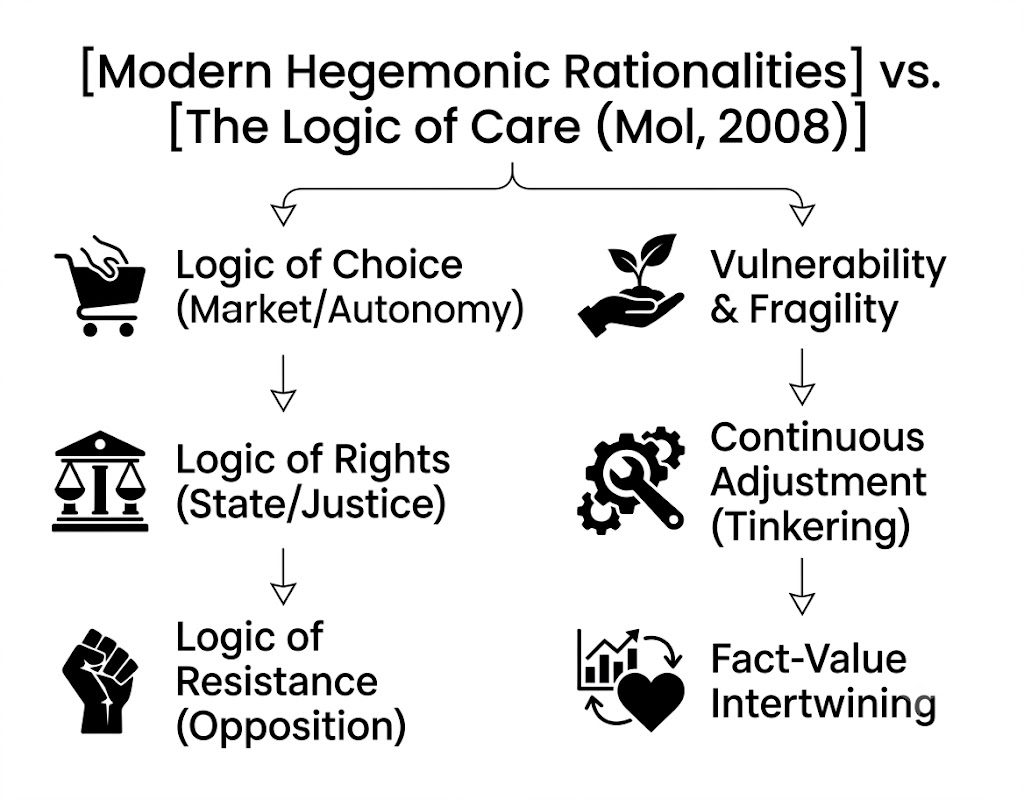
As Annemarie Mol (2008) masterfully observes in clinical settings, medical efficacy and moral goodness do not emerge from the rigid application of universal principles or abstract autonomous choices. Instead, they are continuously negotiated through a process of tinkering (apaño)—a pragmatic, tentative, and persistent manipulation of bodies, technologies, and environments.
This logic of care fundamentally destabilizes the classical dualism between facts and values. When a diabetic patient's blood sugar level is calibrated, or when a specific material adjustment is made to a wheelchair, are we witnessing a purely technical fact or a deeply normative value? Within this framework, facts and values collapse into a single entity: the fact-value. Life is no longer treated as an objective, biological given, but as an ongoing task. Consequently, the central question shifts from an abstract ethical inquiry (how to be moral) to a practical, existential drive (how to maintain morale amidst vulnerability). Care is inherently precarious; its success is never definitive, and its failures do not invalidate its necessity but rather demand a different configuration of the assemblage.
The Post-human Expansion: Matters of Concern and Matters of Care
If care is defined by this adaptive tinkering, who—or what—is allowed to act within this relational network? The empirical sociology of care has increasingly destabilized human exceptionalism by demonstrating that the survival of our common world relies on heterogeneous socio-technical and organic assemblages. Sociological research on agricultural practices during epidemiological crises, for instance, highlights how "living together adaptively" requires recognizing the active agency of animals. Similarly, the study of tele-care and high-tech domestic medicine shows that breathing apparatuses, digital interfaces, and physical spaces are not neutral instruments; they are active participants that demand accommodation and redistribute responsibility.
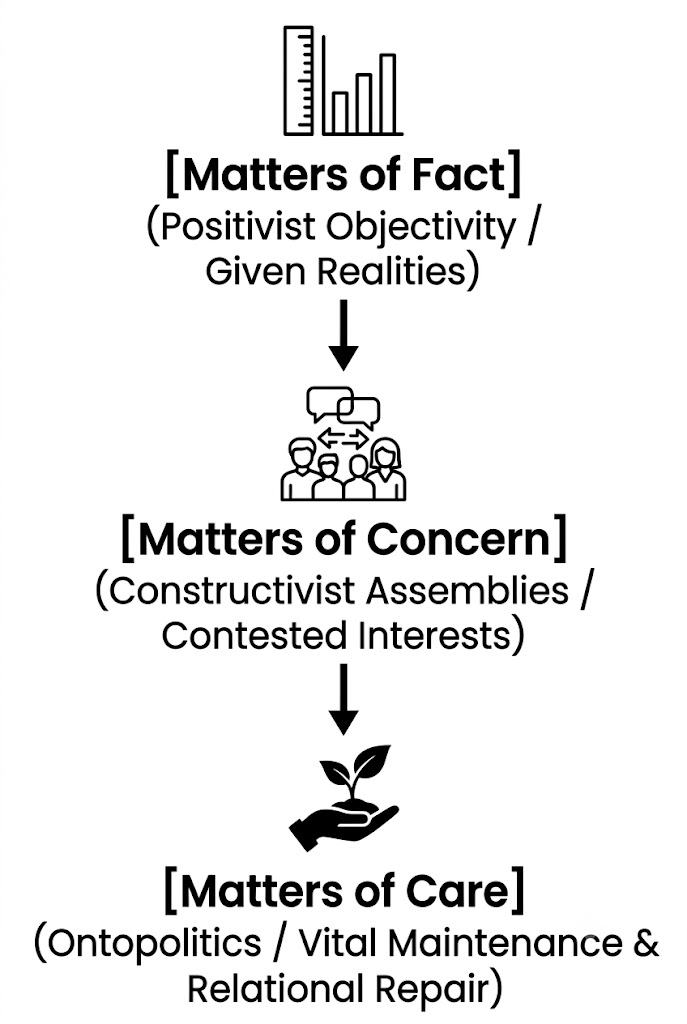
This empirical turn allows us to bridge the logic of care with the social studies of science and technology. By drawing on Bruno Latour’s (2004) seminal distinction, we see a shift from unexamined "matters of fact" to highly contested "matters of concern." Knowledge production and technological stability are not reflections of a pre-existing external reality, but the result of continuous, localized maintenance work.
Yet, as María Puig de la Bellacasa (2011) powerfully argues, moving from facts to concerns is not enough. We must advance toward matters of care. To care for a thing is to intervene in its existential trajectory, to recognize that nothing subsists without an active web of maintenance and repair. This shift is vividly illustrated in contemporary ethnographies of institutions like the Museum of Modern Art (MoMA), where the very existence of a masterwork is revealed to be a precarious effect of ongoing biochemical, financial, and discursive care (Domínguez-Rubio, 2020).
The Ambivalences of the Ontopolitical Turn
To argue for an ontopolitics of care is not to romanticize it. Indeed, a critical sociology must ask: what forms of violence, exclusion, and colonial subjugation are hidden behind the premise of protection? Care is fundamentally ambivalent and situated. Historically, transnational health programs and developmental initiatives have frequently functioned as vehicles for racialized and colonial governance, enforcing coercions under the guise of benevolence. Furthermore, certain institutionalizations of care can exert a conservative force, smoothing over deep socio-economic structural inequalities and neutralizing the radical potential of political antagonism by offering mere palliative repair.
Therefore, an ontopolitical approach does not conceptualize care as a harmonious moral imperative, but as an unstable, frequently asymmetrical circulation of power and affect. It demands an intersectional sensitivity that interrogates who is assigned the burden of care, whose bodies are rendered invisible in global affect chains, and which entities are selected to be deemed worthy of maintenance while others are left to decay.
Existence as Being-With...
Ultimately, tracing the trajectory of care studies reveals a profound shift from an ethico-social framework to a generalized ontopolitics. The determination of what is possible, what is sustainable, and what exists is not fixed prior to the practices of care, but is dynamically co-produced through them. This perspective invites sociology to transcend the Weberian or Foucaultian focus on power as governance, control, or subjection. Instead, drawing closer to a Spinozian or Trontian lineage, power within the ontology of care is reimagined as the capacity to sustain, foster, and preserve life within a vulnerable, shared environment. We are not isolated subjects looking at a detached world; we are thoroughly entangled in it. In a world defined by radical interdependence, the defense of care practices is not a matter of moral preference, but the very condition of our collective survival.
References
-Domínguez-Rubio, F. (2020). Still life: Ecologies of the modern imagination at the art museum. University of Chicago Press.
-García Selgas, F. J., & Martín Palomo, M. T. (2021). Repensar los cuidados: De las prácticas a la ontopolítica. Revista Internacional de Sociología, 79(3), e188. https://doi.org/10.3989/ris.2021.79.3.20.68
-Latour, B. (2004). Why has critique run out of steam? From matters of fact to matters of concern. Critical Inquiry, 30(2), 224–248. https://doi.org/10.1086/421123
-Mol, A. (2008). The logic of care: Health and the ethics of utility. Routledge.
-Puig de la Bellacasa, M. (2011). Matters of care in technoscience: Assembling neglected things. Social Studies of Science, 41(1), 85–106. https://doi.org/10.1177/0306312710380301
About the Author
The drive to write this essay comes from a necessity to push the boundaries of how we interpret existence, shifting the focus from what humans do to how a heterogeneous world actually survives. My interest in exploring the ontopolitics of care stems from a long-standing dissatisfaction with traditional, rigid frameworks that try to explain collective life through individual choices or abstract legal rights. When observing the delicate scaffolding of our world—whether in a clinic, an agricultural crisis, or the behind-the-scenes preservation of an art museum—it becomes clear that life cannot be reduced to neat, sterile formulas.
For me, this analysis is a vital reminder that understanding social order is fundamentally an interpretive craft, not an exact science. We are not dealing with fixed, predictable equations or hard empirical constants; human and non-human networks are far too precarious, ambivalent, and shifting for that kind of mechanical reductionism. The categories explored here are not absolute truths to be proven, but fluid analytical lenses designed to make the invisible work of maintenance visible. This piece reflects my personal perception of what our inquiry should be: a deeply situated exercise in mapping dependencies, exposing structural asymmetries, and recognizing that we are never detached observers, but thoroughly entangled participants in a world that requires constant repair to exist.