Anatomy of the Routine: Showering, Consumption, and the Architecture of Modern Habits.
Looking beyond the invisible backdrop.
Before we sit down and look at the texts, let’s clear the air on a fundamental truth of our discipline. As sociologists, we know we aren't dealing with immutable, hard-wired natural laws. There are no absolute, fixed empirical answers waiting to be uncovered like fossils in rock. Instead, what we have are analytical categories—conceptual lenses that we invent and refine to help us make sense of the fluid, messy, and deeply organic reality of human life.
With that in mind, let’s explore how we construct our understanding of the everyday world through the lens of Social Practice Theory (SPT), guided by the insights of Tomás Ariztía (2017).
Beyond the Individual and the Structure: The Organic Flow of Social Practices
Have you ever stopped to wonder why you do what you do every morning? Take something as mundane as waking up and jumping into the shower. We like to think of this as a purely personal, rational choice, or perhaps a mechanical reaction to a cultural rule. But the truth is much more fascinating.
For decades, sociology felt caught in a tug-of-war. On one side, we had structuralists telling us that giant, invisible social forces dictate our every move. On the other, individualists claimed we are entirely free agents making isolated choices. But where does life actually happen? It happens in the doing. This is where Social Practice Theory comes in, acting as an organic bridge between the individual and society.
To understand where this comes from, we have to look at the giants who paved the way. Think of Pierre Bourdieu and his foundational concept of habitus (Bourdieu, 1977). Bourdieu suggested that our society is etched right into our bodies—our tastes, our gestures, and our automatic reactions are deeply ingrained dispositions. Yet, how do these dispositions stay alive?
This is where Anthony Giddens (1984) and his Structuration Theory become essential. Giddens pointed out that social practices have a profoundly recursive dimension. This simply means that our everyday routines are self-repeating; they are the very ground upon which social structures are generated and maintained. We create the rules by following them, and by following them, we recreate the rules. It’s a continuous, unfolding loop.
But how do we navigate this loop in real-time? Harold Garfinkel’s (1967) ethnomethodology reminds us that social order isn’t just a script we memorize. It is a highly localized, practical achievement. We are constantly improvising and making sense of our immediate surroundings based on shared, situated knowledge.
''The Three Elements of the Doing...''
In his insightful review, Ariztía (2017) deconstructs how contemporary theorists like Shove, Pantzar, and Watson have crystallized these classic ideas into a beautiful, workable framework. They argue that a social practice isn’t just an action; it’s an active configuration of three shifting elements: competences, meanings, and materialities.
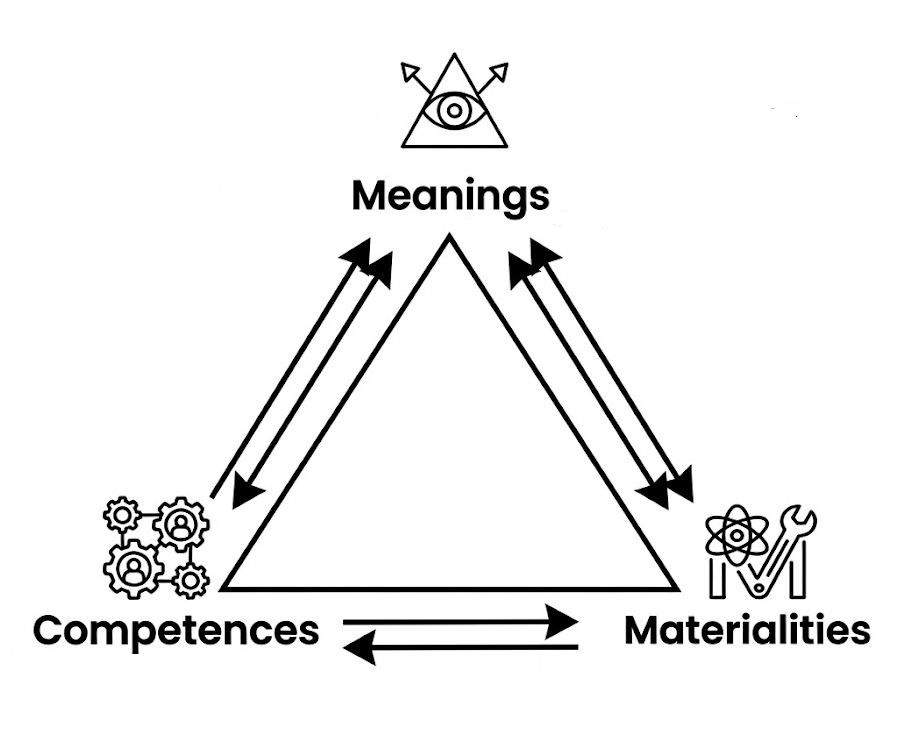
Let’s trace this through Ariztía’s own discussion of the humble daily shower:
Competences: This is the bodily know-how. You don't read a manual to adjust the water temperature, apply soap, or use a towel. Your body just knows how to navigate the space.
Meanings (or Sense): This involves the cultural baggage, emotions, and values we attach to the act. A few generations ago, a bath was a weekly, laborious ritual. Today, the daily shower is tightly bound to modern standards of "cleanliness," "freshness," and productivity.
Materialities: Here is where the framework gets truly radical. Objects are not just passive background props; they have active agency. The shower requires an intricate infrastructure—water grids, plumbing, water heaters, and soap.
What happens when one of these elements shifts? The whole practice morphs or dies. Think about Ariztía’s striking fieldwork example from Hornopirén, Chile (Ariztía, 2017). When solar panels brought electricity to rural homes, families eagerly bought refrigerators. Suddenly, the ancient, deeply embedded practices of smoking and drying food to preserve it fell into disuse. The material changed, the meaning of convenience shifted, and the local competences—the hard-won knowledge of which firewood to use for smoking—gradually faded away.
Performance vs. Entity: How Do Practices Travel?
To make sense of how these routines evolve, Ariztía highlights Theodore Schatzki’s vital analytical distinction between a practice as a performance and a practice as an entity (Ariztía, 2017).
When we look at a practice as a performance, we are looking at the messy, spontaneous, and situated moment of execution. It is you, tomorrow morning, turning the faucet and dealing with a sudden burst of cold water. It’s contingent, alive, and thoroughly grounded in the pragmatism of Garfinkel's world.
But when we view a practice as an entity, we see a historical structure that transcends any single person. The practice of "showering" existed before you were born, and it will exist after you are gone. In this sense, we are not the authors of our practices; we are merely their carriers. We step into them, update them through our performances, and pass them along.
This brings us to a radical redefinition of modern life. Think about our consumption habits. Traditionally, economists view consumption as a matter of individual preference. But from an SPT perspective, consumption is simply a "moment" of a practice (Warde, 2005). You don't buy a car or electricity because you desire the raw object; you consume them because they are structurally required to execute the practices of commuting or keeping your house warm.
The Horizons and Limits of Our Lenses
Every analytical category has its limits, and Ariztía doesn't shy away from pointing out where SPT stumbles. If everything is an interconnected web of routines, where does power hide?
The truth is, SPT can sometimes paint a picture of social life that is a bit too harmonious, failing to fully account for deep structural asymmetries, class struggles, or political hierarchies. Furthermore, while it does an exceptional job explaining the micropolitics of our bathrooms, kitchens, and daily commutes, it struggles to scale up. How do we use a theory built on daily habits to analyze global financial markets or the inner workings of the State?
We tackle these limits not by throwing the categories away, but by weaving them together with other frameworks, such as Actor-Network Theory, to see how massive sociotechnical systems enforce a specific version of "normal" life upon us.
Ultimately, looking at the world through social practices forces us to appreciate the profound weight of the ordinary. It reminds us that society isn’t just held together by laws or grand ideals, but by the quiet, repetitive rhythm of our daily habits.
References
-Ariztía, T. (2017). La teoría de las prácticas sociales: particularidades, posibilidades y límites. Cinta de Moebio, (59), 221-234. https://doi.org/10.4067/S0717-554X2017000200221
-Bourdieu, P. (1977). Outline of a Theory of Practice. Cambridge University Press.
-Garfinkel, H. (1967). Studies in Ethnomethodology. Prentice-Hall.
-Giddens, A. (1984). The Constitution of Society: Outline of the Theory of Structuration. University of California Press.
-Warde, A. (2005). Consumption and theories of practice. Journal of Consumer Culture, 5(2), 131-153. https://doi.org/10.1177/1469540505053090
About the Author
Writing this particular piece was an immensely enjoyable and nostalgic process for me. Revisiting thinkers like Bourdieu, Giddens, and Garfinkel felt less like an academic task and more like catching up with old friends—minds I first encountered during my very first years at university. Because of that, diving back into their concepts felt incredibly natural, intuitive, and deeply familiar.
Ultimately, re-engaging with these ideas reminds me that making sense of human life is never about finding absolute, fixed answers, but about crafting better lenses to view a constantly moving target. It is an invitation to look at our everyday surroundings and realize that nothing is purely accidental. The objects we handle, the spaces we inhabit, and the routines we repeat are all quiet, interconnected currents. For me, the true beauty of this kind of analytical work lies right there: it transforms the invisible backdrop of our lives into a living, breathing map, showing us that even in our most solitary routines, we are always profoundly woven into a shared human story.
(what if the very act of defining these categories so sharply is, in itself, a small nod to academic rigidity?) :o